Empire Capital Research

Research built around the decisions that matter.

Explore independent analysis of Bangladesh's markets, economy, companies, industries and policy environment.

Editors' selection

Flagship reports and timely analysis selected from our published research.

View latest research
DSEX Ends Third Consecutive Week Lower Despite Strong Late-Week Breadth Recovery
Market update5 min readMember

DSEX Ends Third Consecutive Week Lower Despite Strong Late-Week Breadth Recovery

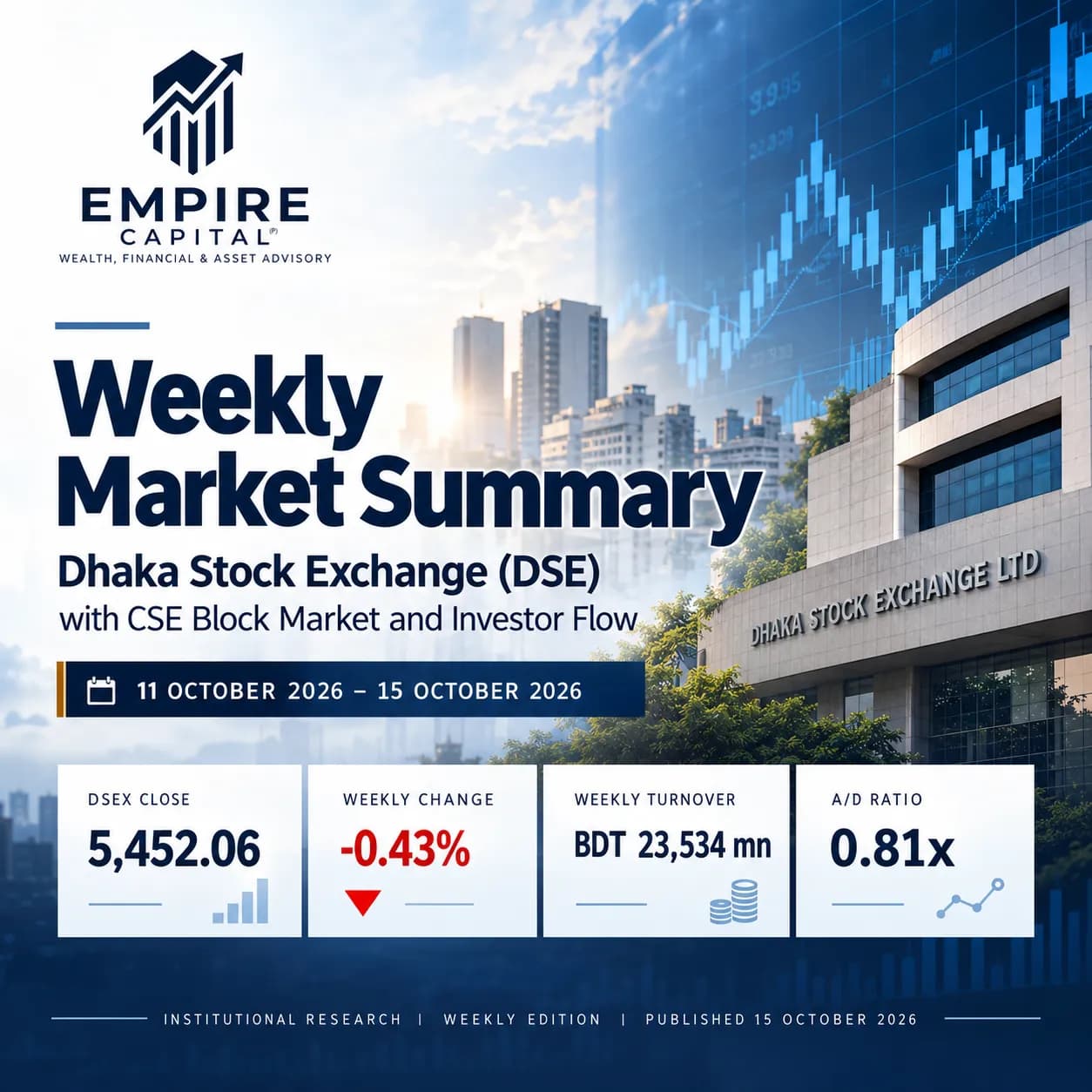
DSEX closed the week at 5,452.06, down 0.43%, marking a third consecutive weekly decline. After falling to 5,404.87 on 12 October, the index recovered across the final three sessions as breadth strengthened sharply, with the A/D ratio reaching 2.67x on 15 October. However, weekly turnover declined 15.42% to BDT 23.53 billion, keeping liquidity subdued despite improving market participation.

Read the research

Interactive topic navigator

The Research Atlas

Nine specialist research desks. Select a subject to reveal its latest analysis.

Selected desk: Capital Markets
Capital Markets research desk

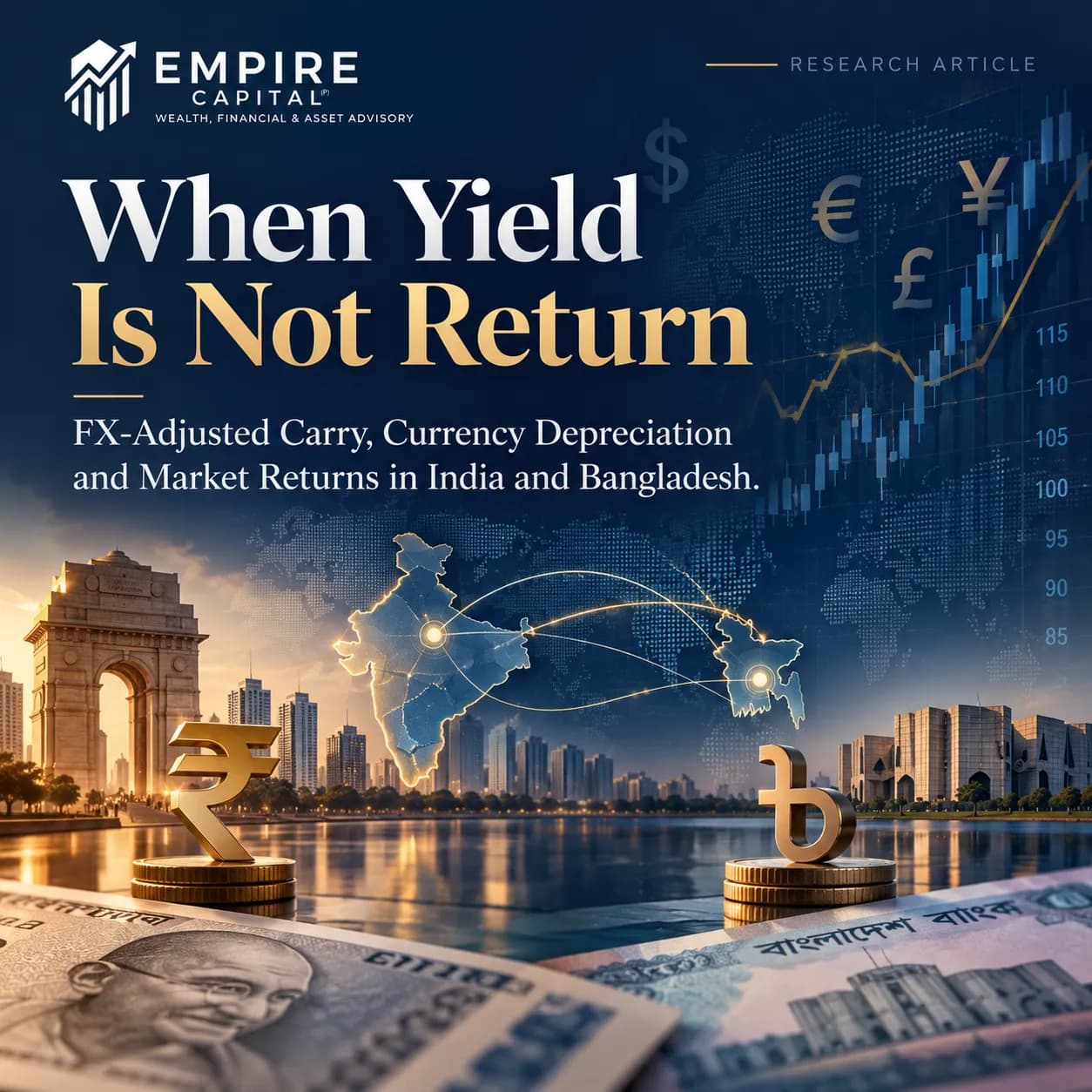
When Yield Is Not Return

Headline yields can overstate the returns ultimately realised by global investors. This research compares India and Bangladesh through an FX-adjusted lens, examining long-term currency depreciation, sovereign carry and equity-market returns in USD terms. It finds that India has experienced greater long-run currency depreciation since 2010, while Bangladesh has faced the sharper adjustment since 2018, highlighting why local returns must be assessed after currency translation and against the US Treasury opportunity cost.

When Yield Is Not Return
Investment perspectives

Opinion & Editorial

Published viewpoints from Empire Capital's research platform.

Explore all perspectives
Capital Markets · Investment Perspectives6 min readMember

When Yield Is Not Return

Headline yields can overstate the returns ultimately realised by global investors. This research compares India and Bangladesh through an FX-adjusted lens, examining long-term currency depreciation, sovereign carry and equity-market returns in USD terms. It finds that India has experienced greater long-run currency depreciation since 2010, while Bangladesh has faced the sharper adjustment since 2018, highlighting why local returns must be assessed after currency translation and against the US Treasury opportunity cost.

Read the full perspective
Investment Perspectives5 min readMember

DSEX Technical Analysis and Projection: October–December 2026

The DSEX entered Q4 2026 in a medium-term correction while its longer-term uptrend remains intact. The index closed at 5,482.36 on 4 October, below its 20-day, 50-day and 100-day moving averages but still above the 200-day SMA. The report identifies 5,376–5,393 as the decisive support zone for the quarter. The base-case scenario, assigned approximately 50% probability, anticipates a range-bound market with a downward bias, broadly between 5,376 and 5,700, with a potential year-end range of 5,400–5,600. A sustained breakdown below 5,376 would increase downside risk toward 5,290–5,340 and potentially 5,110–5,200, while a recovery above 5,632 and subsequently 5,694 with stronger turnover would improve the technical outlook

Read the full perspective
Investment Perspectives10 min readMember

Bangladesh Equity Market: Attractive Valuations, Currency-Aware Returns and the Case for Selective Investment

This paper evaluates Bangladesh equities through valuation, market performance, foreign participation and currency-adjusted returns. The framework combines DSEX performance, foreign portfolio equity flows, market P/E, dividend yield, Bangladesh and US 10-year yields, USD/BDT movements and a calculated USD investor real-carry spread. The analysis highlights valuation compression, weak foreign participation, benchmark dispersion and the importance of currency stability, liquidity and selective portfolio construction.

Read the full perspective
Research centre

Find the exact publication you need.

Search the archive by topic, format, company, industry or publication date.

Enter the Research Centre