
Capital Markets
Analysis of listed equities, liquidity, valuation and market structure across the Dhaka and Chittagong exchanges.
Lead publication
The newest research from Empire Capital's capital markets desk.
 Featured research
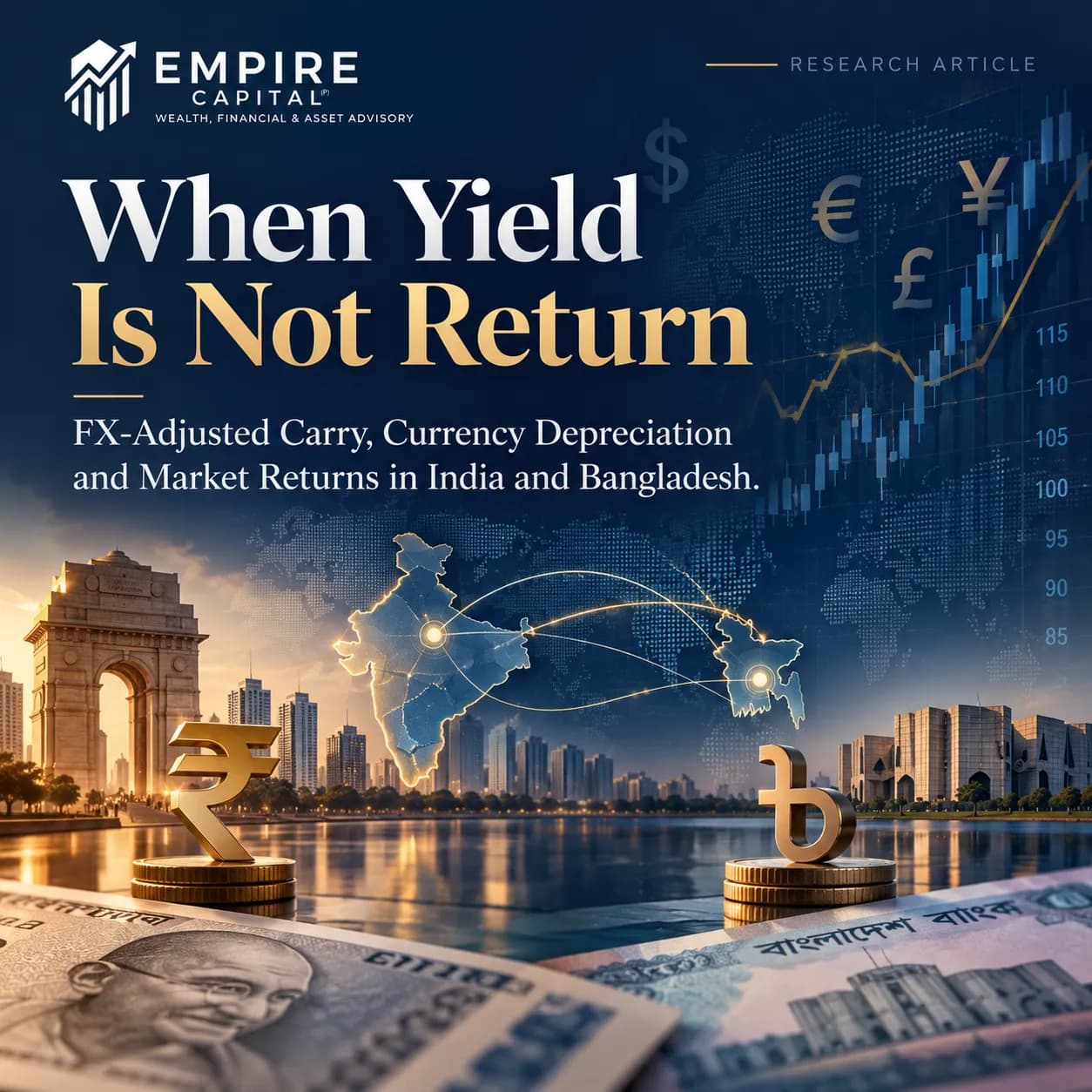
When Yield Is Not Return
Headline yields can overstate the returns ultimately realised by global investors. This research compares India and Bangladesh through an FX-adjusted lens, examining long-term currency depreciation, sovereign carry and equity-market returns in USD terms. It finds that India has experienced greater long-run currency depreciation since 2010, while Bangladesh has faced the sharper adjustment since 2018, highlighting why local returns must be assessed after currency translation and against the US Treasury opportunity cost.
Read the publicationMore from Capital Markets
 01
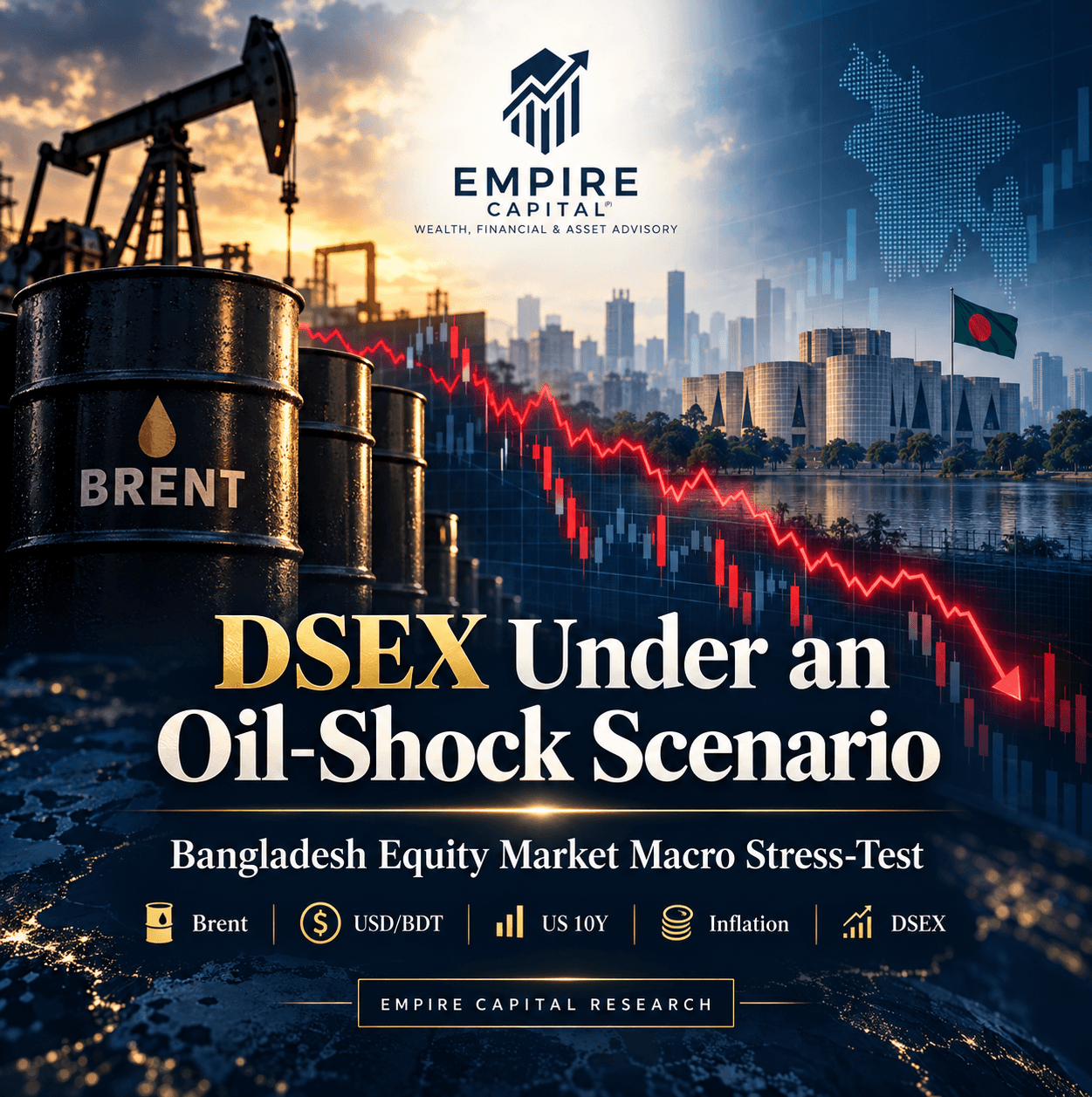
01DSEX Under an Oil-Shock Scenario
How vulnerable is Bangladesh’s equity market to another global oil shock? Empire Capital Research examines the transmission of Brent crude, USD/BDT, inflation, global bond yields and domestic funding conditions into DSEX. The report uses the July 2022 Brent high of $121.80 per barrel as a historical stress reference and develops scenario-based DSEX risk zones while distinguishing analytical stress testing from market forecasts or price targets.
 02
02DSE INVESTOR PARTICIPATION WEEK-BY-WEEK ANALYTICAL REVIEW 2 August - 17 September 2026
Investor participation data indicates a shift in market composition during 13–17 September 2026, with institutional participation rising to 9.69% and foreign participation increasing to 2.03%. Combined institutional and foreign participation reached 11.72%, while retail participation declined to 85.72%, the lowest level in the seven-week review period. The analysis highlights stronger institutional involvement while noting that participation share does not confirm net buying or capital inflows without directional flow data.
 03
03Brent Crude Oil: Forward Price Trend Outlook
Brent crude remains elevated amid near-term geopolitical and supply risks, but the futures curve continues to signal a downward normalization path through 2027. Empire Capital Research expects high event-driven volatility through late 2026, followed by a gradual easing in prices as supply conditions improve and demand pressures build.
 04
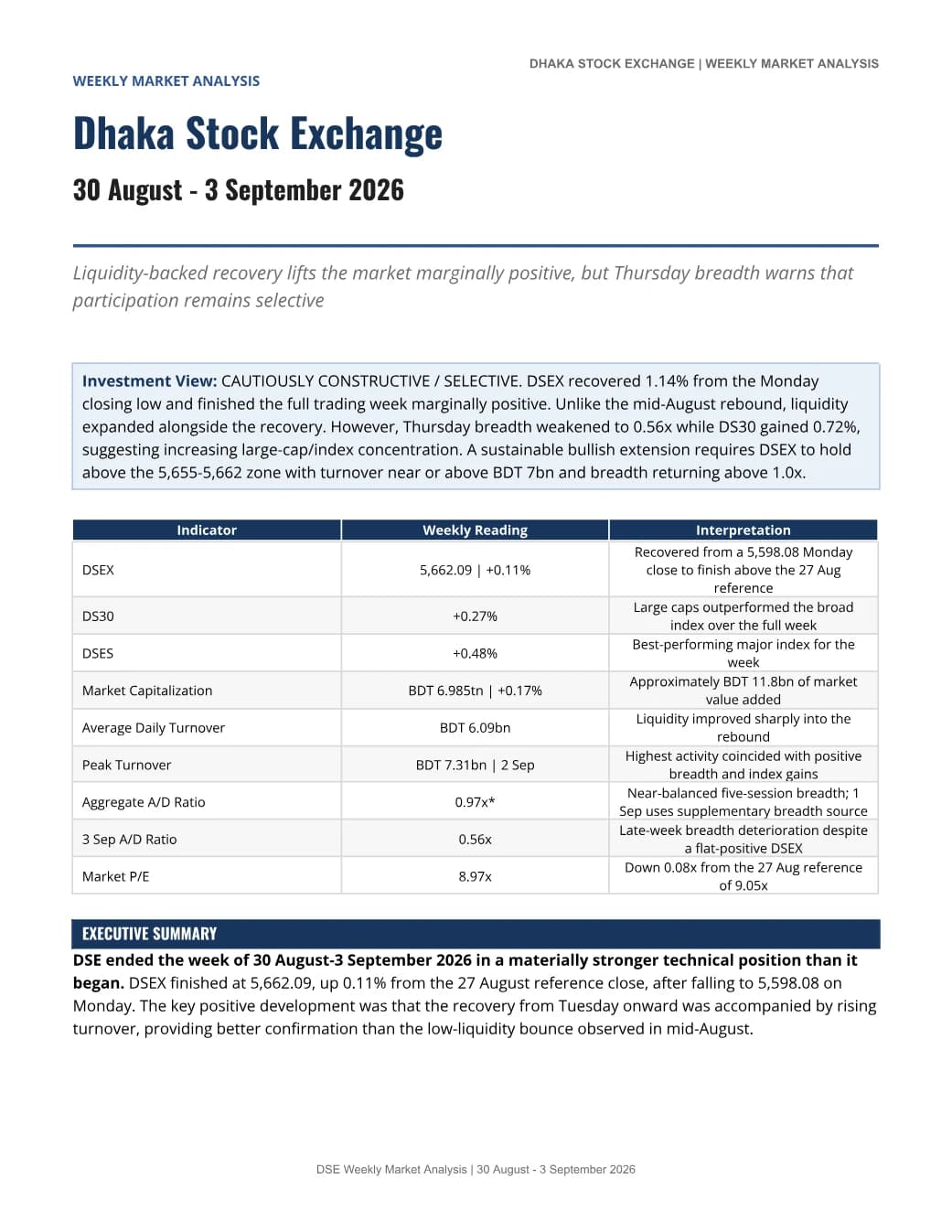
04DSE Weekly Market Analysis: Liquidity-Backed Recovery, Selective Participation
The market finished the week marginally positive at 5,662.09 with average daily turnover of BDT 6.09bn, the liquidity confirmation absent from the mid-August bounce. Thursday's weak breadth alongside a 0.72% DS30 gain points to large-cap concentration rather than broad participation.
 05
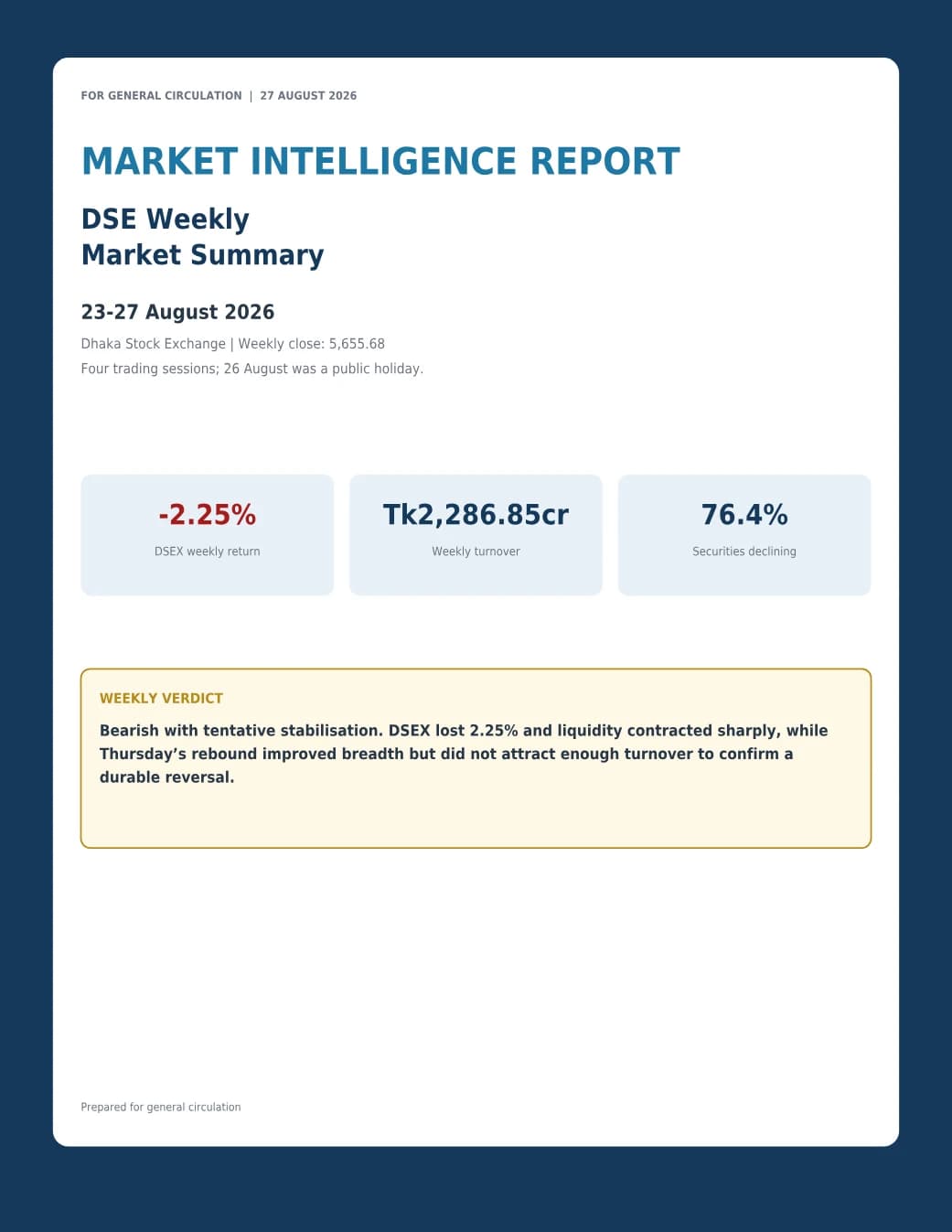
05DSE Weekly Market Summary: Bearish With Tentative Stabilisation
A four-session week in which DSEX fell 130.40 points to 5,655.68 while average daily turnover dropped to Tk571.71 crore. Thursday's rebound improved breadth but attracted no fresh liquidity, leaving stabilisation visible and reversal unconfirmed.
 06
06DSEX under pressure: Why 6,000 failed and what the next move depends on
A multi-factor repricing has put market breadth, energy constraints and the 5,674 support reference into focus.
 07
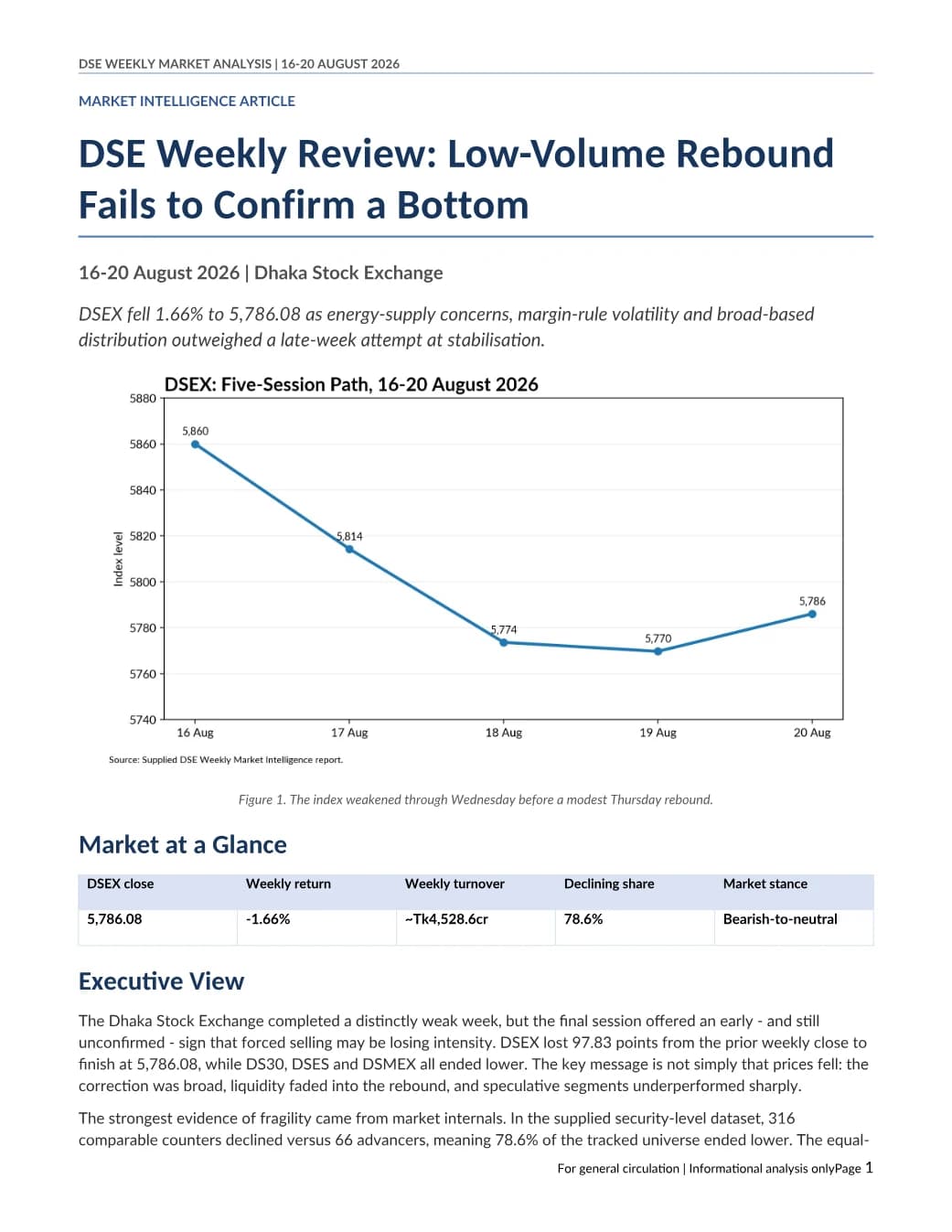
07DSE Weekly Review: Low-Volume Rebound Fails to Confirm a Bottom
A corrective week in which 78.6% of tracked counters declined, DSMEX fell 5.36% and turnover faded into Thursday's rebound. The analysis covers index structure, breadth, the drivers behind the sell-off, stock dispersion and the technical levels that would define a recovery.
 08
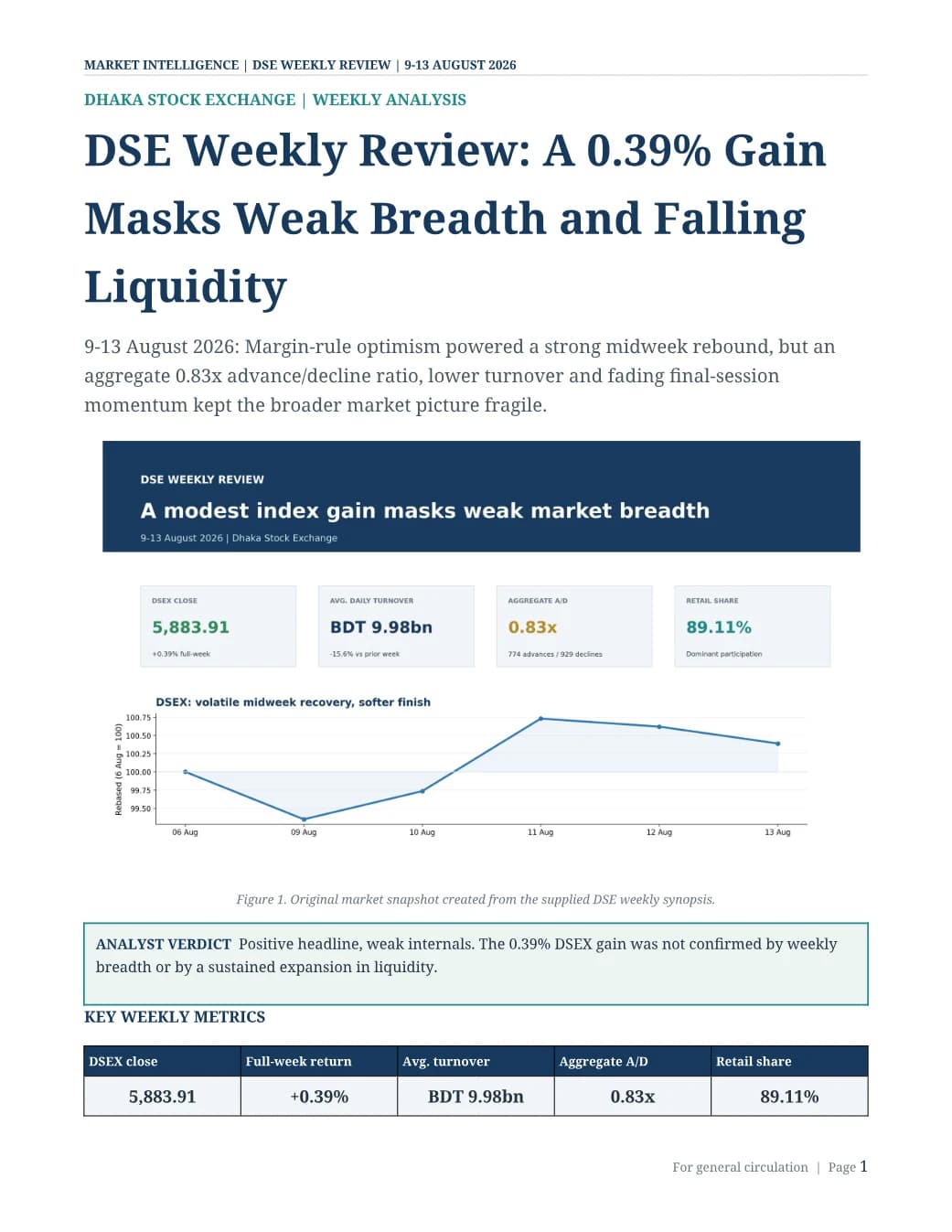
08DSE Weekly Review: A 0.39% Gain Masks Weak Breadth and Falling Liquidity
DSEX closed the 9-13 August week at 5,883.91, up 0.39%, yet advances trailed declines 774 to 929 for an aggregate 0.83x A/D ratio and average daily turnover fell 15.6% to BDT 9.98bn. A review of breadth, liquidity, sector concentration and retail participation.
Looking for a specific market, company or theme?
Search the complete archive across every Empire Capital research desk.
Search all research