

Understanding your rights is essential to protecting your investments. This Empire Capital Research guide explores investor protections in Bangladesh, including shareholder rights, broker obligations, BO-account safeguards and complaint procedures. It also examines key regulatory developments in 2026, legal deadlines and the remedies available when investor rights may have been violated.

EMPIRE CAPITAL RESEARCH
INVESTOR RIGHTS IN
BANGLADESH'S CAPITAL MARKET
A practical legal and market-structure guide for investors
FIVE CORE QUESTIONS | 2026 REGULATORY UPDATES | INVESTOR REMEDIES
Research cut-off: 1 November 2026
Jurisdiction: Bangladesh • Exchanges: DSE and CSE
Investor Centre / Investor Protection / Research Series
Executive perspective
Investor protection in Bangladesh is not a promise against market losses. It is a framework of enforceable legal rights, prescribed disclosures, duties owed by regulated intermediaries and procedures for rectifying misconduct. A person trading equities can simultaneously be a brokerage customer, a BO-account holder and a company shareholder. Each role creates different entitlements and different complaint routes. [S1–S4]
This integrated report combines fundamental rights, current laws and institutions, stockbroker/merchant-bank/DP obligations, ownership rights, and remedies. It also adds the material gaps identified during the editorial audit: IPO subscriptions, margin borrowing, nominee and succession matters, broker default, whistleblowing, insider trading and 2026 dispute procedures.
Research controls Only numerically verifiable official regulatory limits and an official complaint-dashboard snapshot are charted. No stock return, market-volume, recovery-rate or settlement-outcome figures have been invented. Where a law depends on a later amendment or the account agreement, that caveat is stated. |
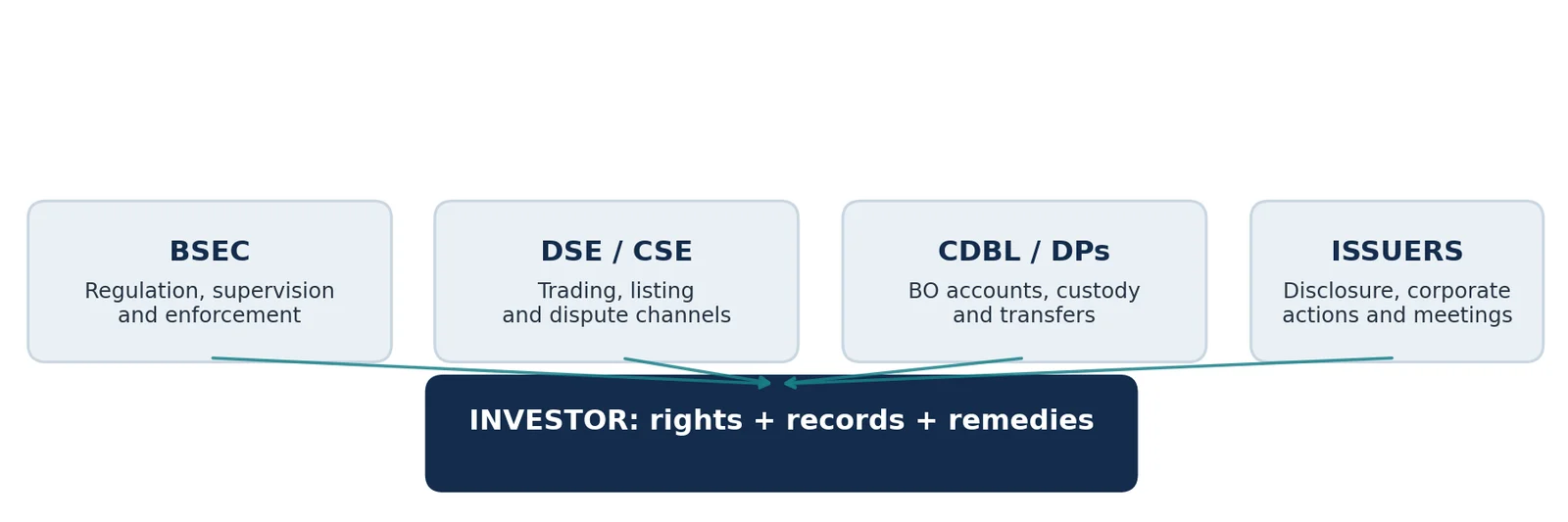
Figure 1. Bangladesh capital-market investor-protection ecosystem. Institutional roles are distinct (conceptual diagram; not a quantitative ranking).
Five questions answered in brief
Question | Answer in one sentence |
|---|---|
1. Fundamental rights | Protection against unlawful conduct; prescribed disclosures; authorized dealing; custody; ownership entitlements; and access to remedies. |
2. Legal foundations | The 1969 Ordinance, 1993 BSEC Act, 1994 Companies Act, 1999 Depositories Act, BSEC rules and exchange regulations. |
3. Intermediary relationships | Valid instructions, confirmation, customer-asset protection, relevant statements, lawful margin terms and proper depository services. |
4. Securities ownership | Rights vary by instrument: dividends/votes for eligible shares, debt payments and covenants for bonds, fund-document rights for units. |
5. Suspected violation | Document the facts, complain in writing, choose the relevant exchange/regulator channel and observe statutory time limits. |
1 | Fundamental investor rights: what the law actually protects
There is no single universal statutory “investor bill of rights” applying identically to every instrument. Rights arise from legislation, regulations, recognized exchange procedures, the terms of the security and the contract with the intermediary. Investors should distinguish a mandatory legal duty from a good-practice recommendation.
1.1 Rights of market participants
- Access to prescribed, timely market disclosures: listed issuers must make specified periodic reports, price-sensitive information and corporate-action communications available to the market. A right to disclosure does…
Continue reading the full analysis
The remaining research is delivered only after server-side access verification and is not included in this page response.