

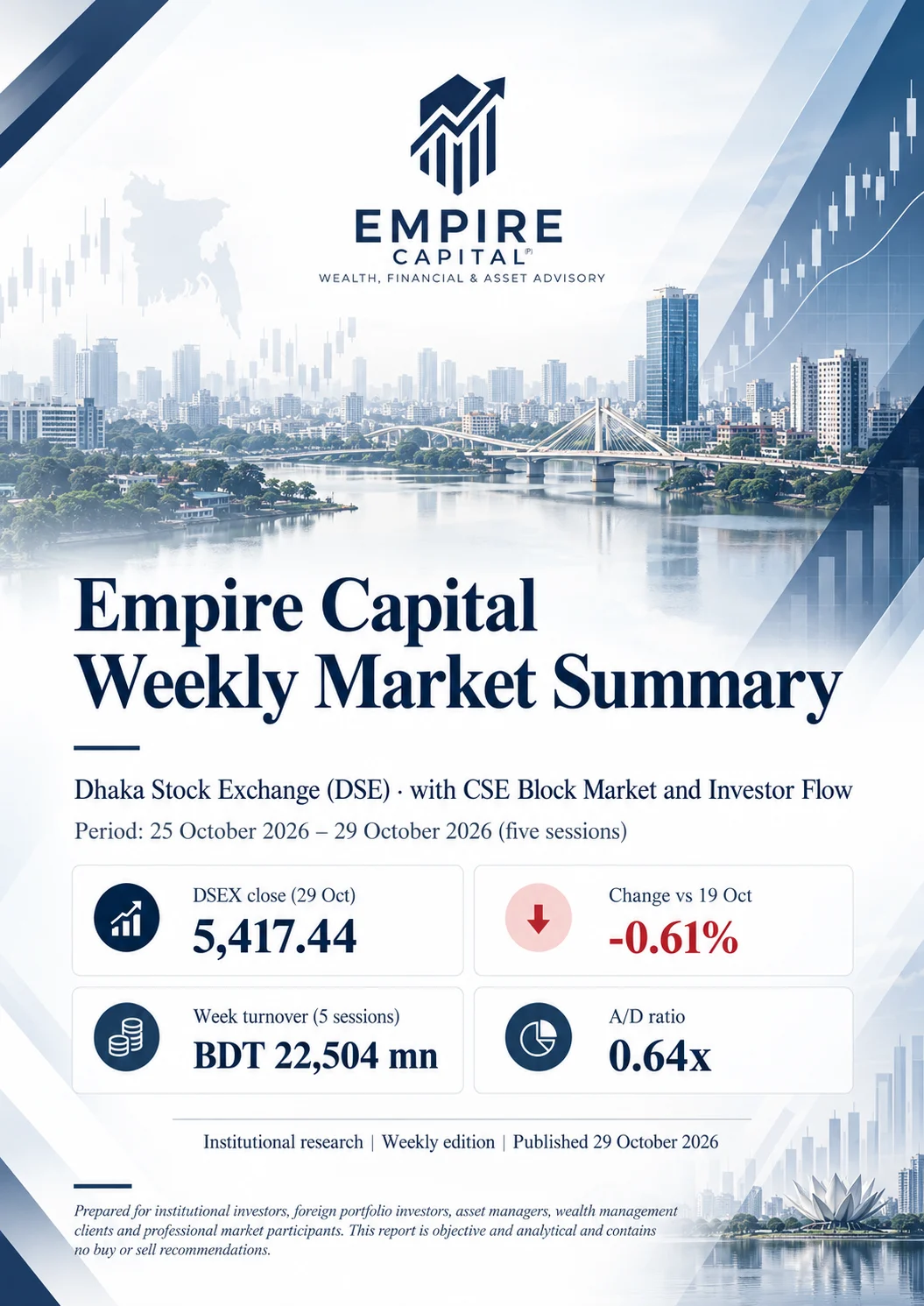
Bangladesh's stock market remained under pressure during 25–29 October 2026, with the DSEX declining 0.61% to close at 5,417.44, marking its fifth consecutive weekly decline. The index also ended October 2.40% lower. Average daily turnover increased 13.88% to BDT 4,500.76 million, although block transactions significantly influenced trading activity. Market breadth remained weak at 0.64x, while retail investors maintained positive buying participation against continued institutional and foreign selling. Despite the decline, technical momentum showed signs of improvement, with RSI rising to 42.6. Empire Capital's analysis identifies 5,365–5,379 as a key support zone and 5,433–5,450 as immediate resistance, suggesting a cautious consolidation phase ahead.
Weekly Market View
1. Executive Summary
Comparison basis. This edition compares the previous trade week, the three pre-holiday sessions of Saturday 17, Sunday 18 and Monday 19 October 2026, with this trade week, the five sessions of Sunday 25 to Thursday 29 October, the first week after the Durga Puja closure (20–22 October). Flow measures (turnover, volume, trades, block value) are compared per session because the weeks have different numbers of sessions; ratios (A/D, block share, net investor flow) are compared directly; index levels are compared week-end to week-end (19 Oct → 29 Oct).
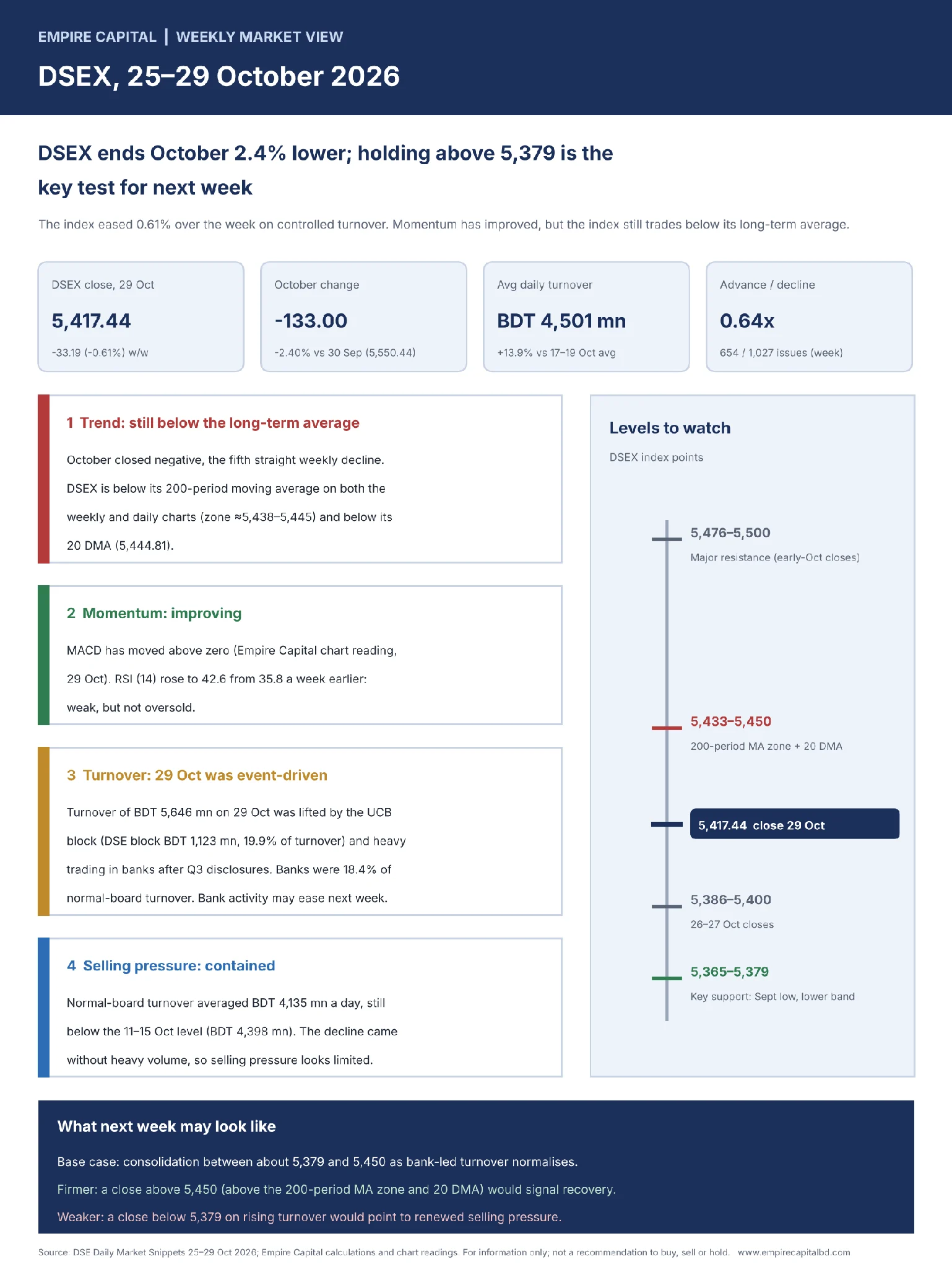
Market direction. The DSEX closed the week at 5,417.44, down 33.19 points (-0.61%) from 5,450.63 on 19 October. It was the fifth consecutive weekly decline. The index fell for the first three sessions to a closing low of 5,386.54 on 27 October, recovered 46.73 points on 28 October on the strongest breadth of the last three weeks (3.46x), and eased 15.83 points on 29 October. The DSEX ended October at 5,417.44 against 5,550.44 on 30 September, a monthly decline of 133.00 points (-2.40%). The DS30 fell 16.54 points (-0.79%) and the DSES 19.73 points (-1.84%).
Technical position. The index is below its 200-period moving average on both the weekly and daily charts (the zone of about 5,438–5,445) and below a 20 DMA that has fallen to 5,444.81. Momentum has nonetheless improved: the MACD has moved above zero (Empire Capital chart reading, 29 October) and the 14-period RSI rose to 42.6 from 35.8. The 27 October closing low (5,386.54) held above the 5,365–5,379 support area (the September low and the lower Bollinger Band, now 5,364.60). Whether the index can stay above this area is the main test for next week.
Liquidity and breadth. Average daily turnover rose to BDT 4,500.76 million from BDT 3,952.08 million (+13.9%), but much of the increase came on 29 October, when total turnover reached BDT 5,646.21 million. That session included BDT 1,123.41 million of DSE block trades (19.9% of turnover), which Empire Capital's desk attributes mainly to a UCB block, and heavy trading in banks around third-quarter disclosures. Normal-board turnover averaged BDT 4,135.49 million a day, +9.8% above the holiday-thinned previous week but below the BDT 4,398.11 million of 11–15 October. Turnover therefore remains controlled, and the week's decline did not come with heavy volume. Breadth was weak at 0.64x (654 advances, 1,027 declines) against 0.66x.
Investor flows. Retail investors were net buyers in all five sessions (average +8.09 pp of turnover against +2.25 pp). Institutions turned net sellers (average -4.01 pp against +0.78 pp), almost entirely because of 29 October (-18.33 pp), the block-heavy session. Foreign investors were net sellers in every session (average -3.14 pp against -2.93 pp).
MSCI November 2026 Index Review
MSCI will resume its regular review of Bangladeshi equities in November 2026, ending the special restrictions imposed in February 2023 after share-price floors were introduced. Results are due on 11 November 2026, with changes effective from 1 December 2026. The review may lead to inclusions, exclusions and weighting changes,…
Continue reading the full analysis
The remaining research is delivered only after server-side access verification and is not included in this page response.